
ABOUT THE LITTLE FIREFACE PROJECT

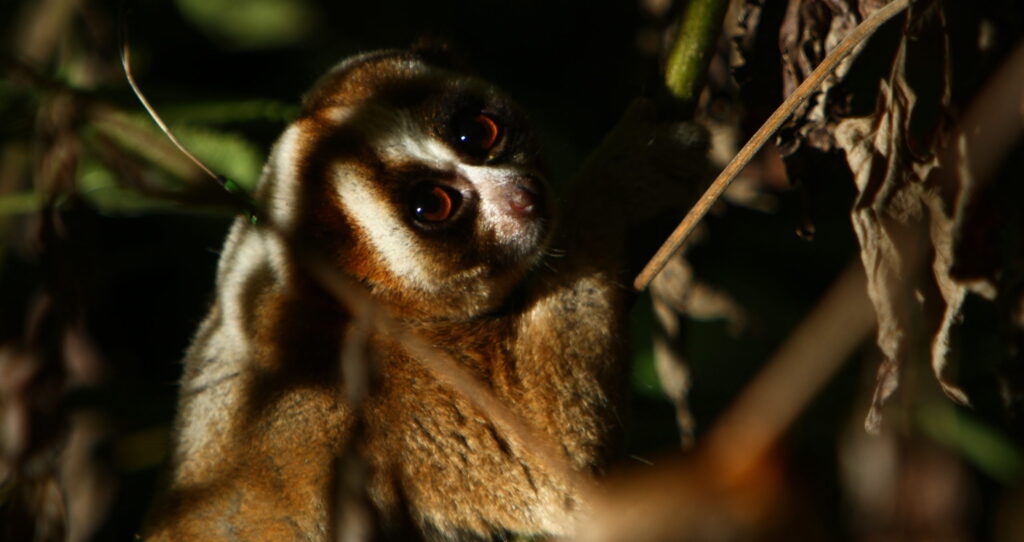
Slow lorises are a unique group of primates found throughout South and Southeast Asia. Their vice-like grip, snake-like movements, shy nature, and most remarkably, their venomous bite, make them unique amongst the primates. They also are to many people undeniably adorable, and to others, nature’s answer to over 100 diseases. Their slow movements make them easy prey to expert hunters who literally empty the forests of these shy primates – amongst the most common mammals seen in Asia’s illegal animal markets, but amongst the rarest spotted even in Asia’s best protected forests.

The Little Fireface Project, named after the Sundanese word for loris, is the world’s longest running loris conservation project, started in 1993, under the auspices of the Nocturnal Primate Research Group of Oxford Brookes University. Our research was highlighted in the award winning 2012 film Jungle Gremlins of JavaWe aim to save lorises from extinction through learning more about their ecology and using this information to educate local people and law enforcement officers, leading  to empathy and empowerment whereby people in countries where lorises exist will want to save them for themselves. This is done through education, media, workshops and  classroom programmes. Our education does not stop in range countries, but also reaches out to potential western purchasers of loris pets.


Photo props – the unknown loris threat - 03/05/2013

A few months back I met Mark Mason, who has been working relentlessly to build a new set of enclosures to house slow lorises confiscated from the Thai photo prop trade on Phuket island. A former MSc student of mine, Petra Osterberg, working with the Gibbon Rehabilitation Project, has been doing the same, and in fact, a large proportion of LFP adoption funds went to fund a cage she built for confiscated lorises.

But where are all these lorises coming from? And why is it so bad that  they are being carried around the beaches of Thailand? Does it hurt them to have some innocent photos taken? Isn’t it a nice experience for a tourist to hold a cute animal?

You think we should have learned from our experiences in the past – the beaches of Spain for instance, where chimpanzees were exploited for a similar trade. No matter how cute the wild animal is, it is that…a wild animal. These poor lorises are ripped from their nocturnal forest homes, dazzled by the very loud noises of the bustling streets. Even many people do not like to be out in the town of Patong at night, with bright lights, loud music and even louder tourists. For a slow loris, whose quiet life in the dark forest, it must be horrific, and it can be seen on the faces of these animals, as camera flash after camera flash sees them recoil in typical fear postures. Lorises too need to hold branches to feel secure, and holding on to a person, while dressed in a clown’s costume, is not security – it is no wonder they grasp for the slender neck of a beer bottle when it is offered.

Lorises naturally look passive and ‘cute’ when terrified. They do not necessarily need to be drugged, though some are. But most do have their teeth cut out. These teeth are vital for grooming and gouging gum, their most important food source, so these lorises cannot be returned to the wild. On top of that, most cannot survive for more than a few months in captivity on a diet of fruit and paraded in such stressful conditions, so need to be replaced with another wild loris.  So the lorises that Mark and Petra are rescuing are in a halfway house – we don’t know where they should go. But we do know that every time a tourist takes a picture with a slow loris laughs and holds it with their friends, they encourage this cruel trade. So PLEASE do not support the photo prop trade.

Take a moment to see that these lorises can have a better life. Thanks to Mark and Petra for their work in giving some of them a second chance. These photos are by Mark Mason.