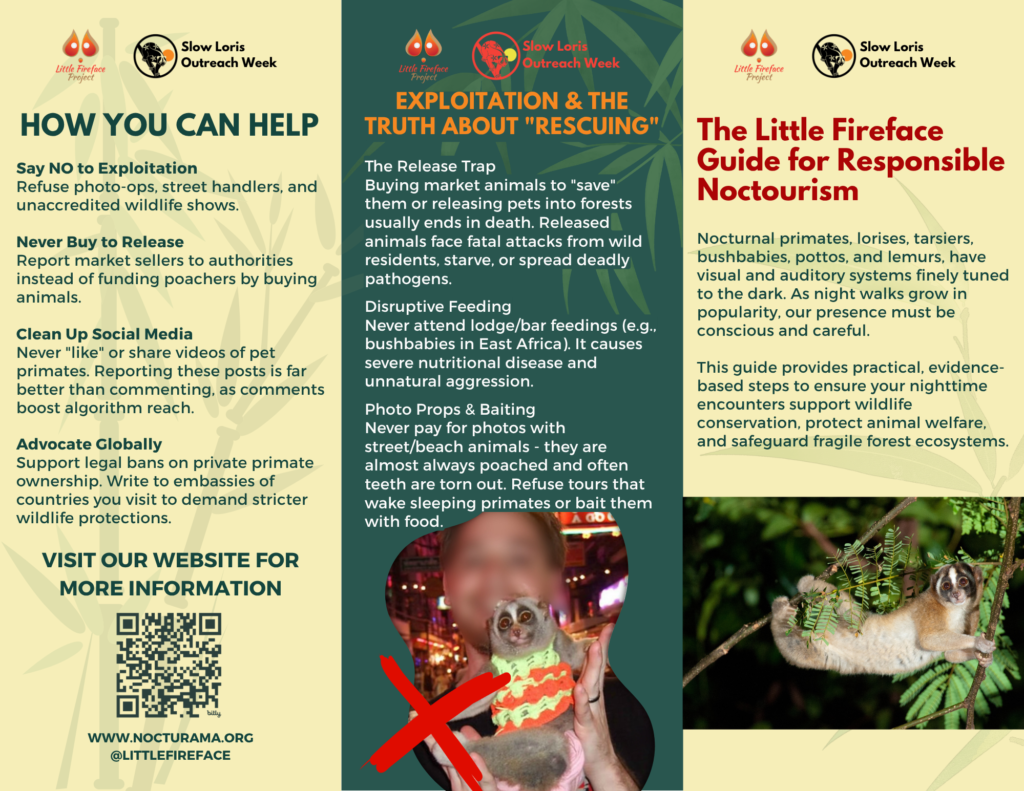
The Little Fireface Guide to Responsible Noctourism
Nocturnal primates have evolved for life in the dark. From slow lorises and tarsiers in Asia to bushbabies, pottos and lemurs in Africa, their visual and auditory systems are finely tuned to nighttime conditions.
As night walks and nocturnal ecotourism become more popular, more people are entering their world.
That creates an opportunity for conservation, but only if we get the encounters right.
Responsible noctourism means keeping wildlife at the centre of the experience. How we use light, how close we get, how long we stay and how we behave can all affect the animals we have come to see.
Here is how to make your night walk better for wildlife.
On This Page
- Red light torch recommendations
- Nocturnal wildlife photography
- Before you book your night walk
- Your night-walk rules
- For guides and tour operators
- When wildlife tourism becomes exploitation
- How you can help
- References
Download our Guide for Responsible Noctourism
Start with the light
For nocturnal wildlife, light matters.
Red light for finding and watching
Many nocturnal mammals, including lorises, are far less sensitive to red wavelengths than to white light. Lorises have a tapetum lucidum, a reflective layer behind the retina that sends light back through the photoreceptors, helping them see in near-darkness.
Sustained bright white light can damage their eyes, not just alter their behaviour.
Use red light when searching for and observing lorises.
Switch torches and headlamps to red mode before entering the forest. Your eyes will adapt to the darkness, and red light also makes natural eye-shine easier to spot.
Hold a handheld torch around eye level when searching for eye-shine. Tarsiers do not have the same eye-shine, but their eye glare is better seen under red light.
Isn’t it just about brightness?
Intensity matters too, but colour is not a minor detail on top of it.
A loris’s eyes are tuned to pick up blue-green light far more efficiently than red. At the same brightness, a red torch causes much less retinal damage than a white one, because the retina absorbs so much less of it. Colour determines how much of a light’s output actually reaches and harms the retina, not just how bright it looks to us.
That covers physical damage, but disturbance is a separate issue on top of it. A bright light of any colour can still startle an animal, interrupt feeding, or push it away from a good site, even if it isn’t harming the eyes. That’s why colour, distance and time all matter together: red light reduces the risk of retinal damage, while keeping your distance and limiting viewing time reduces the risk of disturbing natural behaviour.
What about white light?
White light should not be used to spotlight an animal.
If white light is genuinely needed for navigating difficult or uneven terrain, use it only when necessary and switch back to red light immediately when scanning for or viewing wildlife.
Red torch recommendations
Red light is already standard practice in most nocturnal hobbies, stargazing, hunting, you name it, wildlife night walks are honestly one of the only places it’s not the default yet, so there’s no shortage of reviews online if you want help choosing a torch, for example BBC Sky At Night Magazine and Space.com.
Headlamps
Research grade:
Clulite Pro Beam 510 Head Torch – red filter sold separately
Wolf Eyes Dingo21 RED LED headlamp
Recreational:
Black Diamond Spot 400
WINDFIRE Red Light Hunting Headlamp
Handheld torches
Mini Pro LED torch – filter sold separately
You can find more red flashlight recommendations on sites such as Outerspacetrip.com.
What to look for
- A dedicated red-light mode
- Easy access to red light without cycling through bright white light
- A low red-light output
- A beam suitable for walking and locating animals
- A reliable battery and sufficient runtime
- A waterproof or weather-resistant construction suitable for field conditions
A photograph should never cost the animal
Photography is part of modern wildlife tourism. Flash photography is not going away, so the answer is not simply to ban every flash.
The important question is how the light is used.
A well-used camera flash is a brief, diffused burst of light, around 1/100th of a second. A white torch held on an animal is sustained and direct for as long as someone is looking through it.
That means a continuously shone white torch can disturb a loris more than a single, well-timed flash.
Yet many wildlife-viewing codes ban flash while still allowing continuous white-light torches.
That is backwards.
Photograph responsibly
Find the animal with red light.
Use red light to locate and focus on the animal, then switch it off before taking the photograph.
Use one controlled light source.
Where possible, use an off-camera flash. One off-camera flash can be shared by several photographers rather than everyone firing their own.
A single lighting source for the whole group is a proven method used for aye-ayes in Madagascar.
Keep it brief.
Avoid multiple photographers firing flashes at the same animal simultaneously.
Keep your distance.
Light intensity on the animal increases sharply as you get closer. Back away rather than increasing the light.
Protect the habitat too.
Never alter, break or destroy vegetation to get a clearer photograph.
And never catch an animal or move it somewhere else for a “better shot”.
If getting the photograph requires disturbing the animal, the photograph is not worth taking.
Don’t assume you can read a loris
One of the easiest mistakes in wildlife tourism is assuming that an animal will tell you when something is wrong.
With slow lorises, it is not that simple.
“It didn’t seem bothered.”
A loris can continue foraging and moving normally under white light while a stress response and physical damage to the retina are occurring.
Neither is something behaviour reliably tells you about.
Normal-looking activity is not evidence that white light is safe.
“It ran away.”
A loris moving quickly under red light is not necessarily fleeing in alarm.
“Slow” describes the characteristic hand-over-hand locomotion of slow lorises. It is not a fixed speed limit. Lorises can move quickly and directly through the canopy, including when relocating away from disturbance and during completely normal, undisturbed behaviour.
So a briskly moving loris is not automatically a frightened loris.
The problem is assuming that a distressed animal will always look distressed, or that a calm-looking animal must be unaffected.
Because interpreting loris behaviour takes training, responsible encounters should err on the side of caution:
brief light exposure, real distance and minimal noise.
Before you book your night walk
Responsible noctourism starts with choosing the right operator.
Look for a clear wildlife-viewing code
Book with a guide or operator who has a clear code of conduct. If it is not published, ask what rules they follow.
Keep groups small
Book tours that limit groups to around 5 to 6 people. Smaller groups reduce noise and habitat disturbance while providing better viewing opportunities.
Know the warning signs
Be wary of operators who:
- Guarantee a sighting
- Bait animals to appear
- Allow guests to handle wildlife
These are signs of poor guiding practice.
Consider the wider business
Prioritise locally owned businesses that give back to host communities. Check that tour operators, eco-lodges and restaurants do not display captive wildlife or keep illegal pet primates.
Protect wildlife from illness too
Keep vaccinations current. If you feel unwell, cancel your walk. Human pathogens can transfer to wild primates.
Your night-walk rules
Before you enter the forest
- Turn off mobile phones and avoid blue-light screen exposure.
- Avoid strong perfumes and colognes.
- Avoid DEET-based insect repellents.
- Test your headlamp’s red-light setting before entering the forest.
When you find an animal
Keep your distance.
Maintain a minimum distance of 7 metres (23 feet).
A loris that freezes, changes its behaviour or moves away is telling you that you are too close.
Keep quiet.
Loud talking, sudden movements and excited exclamations can be as disruptive as bright light.
Keep the encounter short.
Limit viewing and photography to 5 minutes per animal. A brief, well-managed sighting is better than a prolonged one.
Never interfere.
Never touch, feed or attempt to attract a loris by shaking branches or making sudden noises.
Never reposition an animal for a better view or photograph.
Let your guide control the interaction, respect their experience and follow their instructions.
Leave the forest as you found it
Responsible wildlife tourism extends beyond the animal you came to see.
- Do not smoke, eat or leave litter in the forest.
- Avoid buying souvenirs made from illegally logged hardwoods, such as rosewood, or from unregulated gemstones.
- Leave the area as you found it.
For guides and tour operators
If you run night walks in areas where slow lorises are found, the way encounters are managed can make a real difference to animal welfare and the long-term sustainability of your business.
Make these standards part of the experience
Use red light as standard.
Use red-filtered torches for searching and viewing. Reserve white light and flash for the brief moment of taking a photograph, under the conditions described above.
Control the group.
Cap group sizes around wild loris sightings and enforce a minimum viewing distance.
Brief guests before the walk.
Explain the rules on light, noise, distance and handling before entering the forest, rather than waiting until someone has already broken them.
Control photography.
Agree on a single point of light control for photography: one off-camera flash and one operator rather than every guest shooting independently.
Rotate viewing sites.
Where possible, rotate viewing sites rather than repeatedly visiting the same individual or family group.
Report sightings.
Data from responsible ecotourism can directly support loris research and conservation planning.
When wildlife tourism becomes exploitation
A responsible night walk should never turn a wild animal into a prop, a performance or a product.
Never feed wildlife for entertainment
Avoid venues where wild nocturnal animals are deliberately fed at bars or lodges.
Feeding can disrupt natural foraging habits, cause nutritional disease, increase aggression and expose animals to domestic predators and human illnesses.
Never pay for a wildlife photo prop
Never pay for photographs with wild animals on beaches, street corners or tourist hotspots.
Slow lorises and tarsiers have been used as tourist photo props, with animals sometimes illegally poached, drugged or subjected to painful mutilations such as having their teeth clipped or pulled out.
If an animal is being offered as a photograph, walk away.
Never bait or wake animals
Refuse tours where guides wake sleeping nocturnal animals or lure them with food or insects for photographs.
Wild animals should not have to perform for tourism.
Don’t “rescue” wildlife by buying it
Seeing an animal in a market can trigger an understandable desire to help.
Buying it is not the solution.
Purchasing a captured animal gives money directly to poachers and traders, creating a financial incentive to remove more animals from the wild.
Releasing an unwanted pet or rescued animal into the nearest forest can also have devastating consequences.
Released animals may not survive
Captive or rescued animals released without proper scientific planning may be killed by territorial wild residents, starve in unfamiliar habitats or die from injuries.
Non-native animals can create new problems
Releasing non-native species can create invasive populations that outcompete, attack or interbreed with fragile native wildlife.
Disease can move with released animals
Animals kept in captivity or markets can carry human or domestic pathogens. Releasing them can introduce disease into vulnerable wild populations.
If you see an animal being sold, do not buy it to “save” it. Report the activity to local authorities or a reputable conservation organisation instead.
What you can do after the night walk
Responsible noctourism does not end when you leave the forest.
Don’t support exploitative wildlife tourism
Say no to:
- Wildlife photo props
- Street handlers
- Unaccredited wildlife shows
- Venues that encourage feeding or touching wild animals
Be careful what you support online
Never like, share or comment positively on videos featuring nocturnal primates as pets or photo props.
Report inappropriate posts instead. Comments can increase traffic to them.
Support stronger protection
Support legislation banning the private keeping and trade of primates.
Support accredited, long-term sanctuary care and habitat protection.
If you have visited a country where these issues remain a problem, write to its embassy explaining that you will no longer visit and will encourage your friends not to do so.
Why it matters
Wild slow loris encounters are becoming more common across Southeast and South Asia.
That can be a genuine conservation opportunity.
Tourism revenue can fund habitat protection, give local communities and guides an incentive to keep forest and agroforest standing, and encourage people to value lorises as living wild animals rather than commodities for the illegal pet trade.
But poorly managed tourism can stress animals, push them away from good habitat and disrupt the feeding and social behaviour they depend on.
The difference between good and bad ecotourism comes down to practical choices:
How close you get.
How long you stay.
How many people are present.
How much noise you make.
And above all, how you use light.
SLOW 2026 is about getting that balance right.
See wildlife.
Respect the darkness.
Leave the animal’s night undisturbed.
References
Field practices and photography guidance
Nature TTL, “A Guide to Using Flash with Wildlife”
Nature TTL, “Does Flash Photography Harm Animals?”
Nature TTL, “Ethics in Wildlife Photography: Code of Conduct”
Australian Photography, “Photo Tip of the Week: Master Flash in Your Wildlife Shots”
Audubon, “Audubon’s Guide to Ethical Bird Photography and Videography”
Retinal light damage in nocturnal/scotopic-adapted eyes
Nocturnal primate vision, light colour, and behaviour
Weldon, A., Campera, M., & Nekaris, K. A. I. (2020). Box 24.1: Red light for nocturnal observations. In K. A. I. Nekaris, R. A. Munds, & E. R. Pimley, Trapping, collaring and monitoring the Lorisinae of Asia (Loris, Nycticebus) and Perodicticinae (Arctocebus, Perodicticus) of Africa (pp. 281–284). In K. A. I. Nekaris & A. M. Burrows (Eds.), Evolution, Ecology and Conservation of Lorises and Pottos. Cambridge University Press.
Primate welfare, tourism, rescue/release, and social media exploitation
Nekaris, K. A. I., Musing, L., Vazquez, A. G., & Donati, G. (2016). Is tickling torture? Assessing welfare towards slow lorises (Nycticebus spp.) within Web 2.0 videos. Folia Primatologica, 86(6), 534–551.