New Videos to Counteract YouTube Horrors – Slow Loris

For many of us, slow lorises are cute. You can put them in a pile of garbage and they still look just that!! CUTE! So it is no wonder that a tortured overweight loris on a dirty pile of sheets essentially being tortured still looks, well, cute (according to some 17 million viewers at any rate)…

For non-experts, who cannot read the expressions of fear in the animals’ faces when they watch videos of pet lorises, who cannot tell how much bright light hurts their eyes, who cannot see how starving they are so they eat bananas and rice rather than their beloved gum and insects, who cannot see how desperate they are for a branch so they grab on to an umbrella, they are still that – CUTE. For us here at the Little Fireface Project, we see the demise of a beloved species for a senseless human gain.

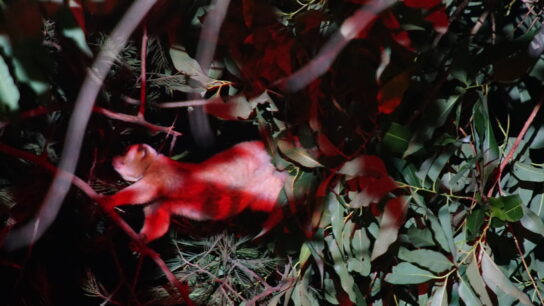
To counteract this, we are introducing a series of videos of these gorgeous animals as they should be. With our rare access to footage of animals in the wild, we hope you can see just how fast the loris can be! How much the move! How many branches they need! How giant their pupils should be. How lovely their fur should look. That is why we film in red and infrared light, so the loris can behave naturally, not terrified by white lights. We hope you can see, as we have done, the real loris, and love them for what they really are.

Congratulations to the world’s newest Loris Doctor

On the 19th of July 2012, Richard ‘Jim’ Moore successfully defended this PhD thesis entitled Ethics, ecology and evolution of Indonesian slow lorises (Nycticebus spp.) rescued from the pet trade at Oxford Brookes University.

I first came to know Richard when he was an undergraduate at Oxford Brookes. After pursuing a degree in Japanese studies, and spending a year abroad in Japan, Richard also started a degree in Anthropology, and successfully procured a scholarship to spend the summer in Sri Lanka studying one of the world’s top 25 most Endangered primates – the Western purple-faced langur. This meticulous study led to three scientific publications.

Richard then spent a field season in Cambodia with me and Dr Carly Starr to study the pygmy slow loris – it was there he earned his nickname Jim, when it was decided the name Richard was just too difficult to pronounce! And also where he decided that he was well-suited to nocturnal fieldwork.

Shortly thereafter, Jim met with CEO of International Animal Rescue Alan Knight who was looking for the perfect person to spend two years on a project that not only required the mental fortitude to deal with the heart break of wildlife trade, but the physical ability to scale one of Java’s most difficult mountains, to monitor scientifically IAR’s release programme of slow lorises. Jim rose to the challenge, to which the successful completion of his PhD attests. Congratulations Dr Richard ‘Jim’ Moore!

Anna Nekaris to speak at Klub Gutenburg 8 Feb

Posted on 03/02/2012

Anna will be speaking about Lorises in Lore, Literature and Legacy in a slot sometime after 7:30 pm but before 11pm on the 8th Febuary at Klub Gutenburg in London.  Please see www.thequietus.com where ticket details will be posted.  Aidan Moffat formerly of Arab Strap will also be strumming some acoustic tunes.

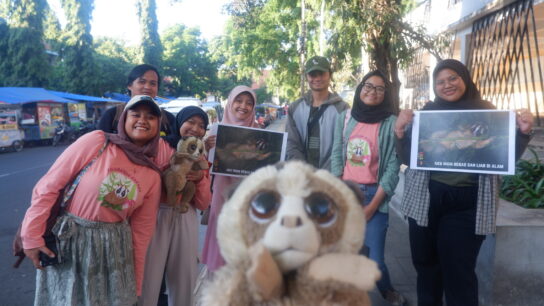
We will also be launching our loris postcard campaign.  We are printing double-sided card with a message to the Indonesian Ambassador in London, regarding the cruelty of illegal wildlife trade and urging the country to enforce their very good laws.  If you wish to download a pdf of the card & could print & distribute it to your colleagues, please let us know, as printing costs are very high and we are only able to do a small print run.

Although people can send the cards to the Embassy, another idea is that Anna will collect a bag of cards and letter and with other important conservation emissaries present the collection to the Indonesian ambassador in London.

Comments from this post

Julia Lindsay-Smith on 03/02/2012 at 20:15 said

I’d be willing to print a pdf of the postcard to get friends and family to send to the ambassador.  I’m sure lots of people on the facebook site would do the same.

Kass on 03/02/2012 at 21:33 said

Would  be happy to print off postcard and hand out to friends.

Pippa on 03/02/2012 at 22:47 said

Hi, could you put the postcard pdf on the website for people to print, hand out and send back to you?  If not please do send it on to me and I will do what I can,

Thanks, Pippa x

Slow Lorises on YouTube – Letter to IPPL


Posted on 25/08/2011

YouTube Video Encourages Illegal Pet Trade in Slow Lorises

K.A.I. Nekaris, A.L. Doughty, Oxford Brookes University, School of Social Sciences and Law, Nocturnal Primate Research Group, Oxford OX3 0BP U.K.

Hill's Greater Slow Loris for Sale in Medan

In the last year two videos showing the Vulnerable pygmy slow loris (Nycticebus pygmaeus) as a pet have gone viral, receiving together nearly 9 million views.  Both videos show the animals in unnatural daylight conditions.  The first is of an obese slow loris being tickled, whereas the second shows a highly stressed obese loris with a characteristic head wound desperate to grasp a tiny umbrella.  Viewers are also allowed to record whether they ‘like or dislike’ the videos.. Combined, as of late March 2011, the two videos received 3100 likes vs only 1200 dislikes.  With more than 9000 comments left on both videos, we were able to categorise them into three major categories: writer endorses pet trade /wants one; writer informs public against having one; writer identifies the species/compares it to film/other.  Through analysis of the first 100 comments, we found that for both videos, nearly 60% of comments were from those who wanted one as a pet or were attracted to the idea of having one, whereas only 5-10% informed the viewers of the illegality of keeping lorises as pets.

Policing the content of videos uploaded to YouTube has been a key problem throughout the company’s rapid evolution.  YouTube has previously stated that it is not their responsibility to control video content uploaded to their site, however they do take copyright infringement seriously.  Other than copyright infringement, content control is maintained through the complaints and notifications from users (Sandoval 2007).  YouTube’s terms and conditions state this it is YouTube’s decision to remove any content that has been flagged as illegal.  Despite 100’s of comments pointing out the cruelty in the video and the illegality of keeping slow lorises as pets, YouTube has done nothing to remove the offensive videos.


Slow lorises do not breed well in captivity, and most that end up as pets will have been smuggled through the black market from the wild.  More often than not, lorises in the trade die due to starvation, dehydration or infection caused through the common practice of removing their teeth with pliers or toe nail clippers, Listed on Appendix 1 of CITES, international trade in slow lorises is prohibited.  It is also illegal to buy the offspring of illegally imported parents.  Social Networking Sites such as YouTube have become an integrated part of personal identity.  We feel that the popularity of these videos could be hazardous to slow loris conservation.  Although the video may also bring their plight to millions who had never heard of the animals before, we strongly urge YouTube to remove the videos.