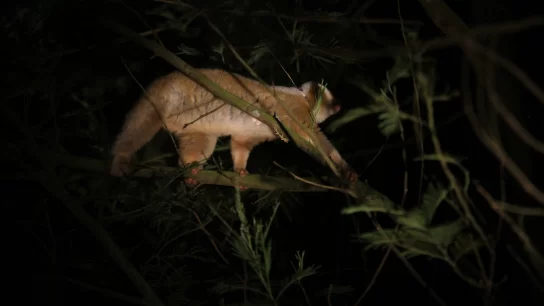
Photo props – the unknown loris threat

A few months back I met Mark Mason, who has been working relentlessly to build a new set of enclosures to house slow lorises confiscated from the Thai photo prop trade on Phuket island. A former MSc student of mine, Petra Osterberg, working with the Gibbon Rehabilitation Project, has been doing the same, and in fact, a large proportion of LFP adoption funds went to fund a cage she built for confiscated lorises.

But where are all these lorises coming from? And why is it so bad that  they are being carried around the beaches of Thailand? Does it hurt them to have some innocent photos taken? Isn’t it a nice experience for a tourist to hold a cute animal?

You think we should have learned from our experiences in the past – the beaches of Spain for instance, where chimpanzees were exploited for a similar trade. No matter how cute the wild animal is, it is that…a wild animal. These poor lorises are ripped from their nocturnal forest homes, dazzled by the very loud noises of the bustling streets. Even many people do not like to be out in the town of Patong at night, with bright lights, loud music and even louder tourists. For a slow loris, whose quiet life in the dark forest, it must be horrific, and it can be seen on the faces of these animals, as camera flash after camera flash sees them recoil in typical fear postures. Lorises too need to hold branches to feel secure, and holding on to a person, while dressed in a clown’s costume, is not security – it is no wonder they grasp for the slender neck of a beer bottle when it is offered.

Lorises naturally look passive and ‘cute’ when terrified. They do not necessarily need to be drugged, though some are. But most do have their teeth cut out. These teeth are vital for grooming and gouging gum, their most important food source, so these lorises cannot be returned to the wild. On top of that, most cannot survive for more than a few months in captivity on a diet of fruit and paraded in such stressful conditions, so need to be replaced with another wild loris.  So the lorises that Mark and Petra are rescuing are in a halfway house – we don’t know where they should go. But we do know that every time a tourist takes a picture with a slow loris laughs and holds it with their friends, they encourage this cruel trade. So PLEASE do not support the photo prop trade.

Take a moment to see that these lorises can have a better life. Thanks to Mark and Petra for their work in giving some of them a second chance. These photos are by Mark Mason.


Introducing Tereh and Bunga

Here at LFP we were SO grateful for the many people who offered to illustrate our children’s book. It was so hard to choose between the adorable sketches, which portrayed the lorises in many different ways, and loris addicts as we are, we hope that none of these efforts will go to waste and we can use all these pieces of art in our conservation education work. In the end, however, the illustrator of our book is Shelley Lowe, an animator/illustrator with a perfect eye for lorises, whose work we hope everyone will love just as much as we do! You can see more of Shelley’s work here.

Bunga has his first go at gouging for gum!

Bunga has his first go at gouging for gum!

Slow Loris Flame Tees Now Available

Our new Flame Tees have arrived!

Sizes and styles available are:

Ladies:
Long Sleeve Hoody Tshirts – £21.50
sm (5), m (0), l (2)

Short sleeve skinny fit – £15.50
Black sm (3), m (0), lg (2)
flame red sm (3), m (1), lg (4)

Men or Women

Regular fit: 15.50
Short sleeve tshirts
black sm (3) md (1) lg (2)
burgundy sm (2) md (1) lg (0)

Children’s

Size 2-3 (1)

Size 3-4 (2)

Size 5-6 (2)

Size 7-8 (2)

Postage & Packing:

£2.20 UK
£3.40 Europe
£5.20 USA/Canada
£6.70 Australia/ Asia

Our Flame Logo was designed by Helga Schulze. It is to represent the plight of the loris, be it perishing due to burning of forest for oil palm, burning in the hot streets when being sold as a pet, or burning in the bright lights of someone’s living room when forced to live as a pet. All shirts glow in the dark! The saying is in Indonesian and English – Don’t Let Me Vanish.

Announcing New Edited Volume – Conservation and Ecology of Asian Slow Lorises

Prof Anna Nekaris will lead the editing of a new volume, on the Conservation and Ecology of Asian Slow Lorises as a special Theme Section issue of the international journal Endangered Species Research.The volume will appear in Summer 2013.

Slow lorises are an evolutionary distinct group of primates found in South and Southeast Asia. All are threatened with extinction not only due to habitat loss, but also due to their high prevalence in Asian traditional medicine, use as tourist photo props, and their high popularity as pets both nationally and internationally. Slow lorises have featured frequently recently in the international media largely due to this conservation crisis. For example, in 2007, they were the first primate since 1986 to be transferred to Appendix I of CITES. From 2009 onwards, they have been a regular feature in the global media as more and more popular media outlets discuss the legality of presence of illegal slow loris ‘pet’ videos on social networking sites.  Finally, the discovery of three new species in 2012 was instantly linked with the fact that these species are not only in sharp decline, meaning bad news for the new taxa, but also with the fact that the loris is the only venomous primate. The latter fact is just one of the many fascinating aspects of ecology within this unique evolutionary group of primates, whose feeding ecology, social behaviour, and even their distribution were not known even ten years ago. In this volume, contributors studying lorises throughout their range in India, Cambodia, Thailand, Borneo, Sumatra, Java, Singapore and Vietnam will bring together the first synthesis of the Conservation and Ecology of this fascinating group of species.

Emergency Guide for Rescuing Slow Lorises

It seems more people have acquired a loris than ever before. The illegal trade in these endangered primates is on the increase. Many people buy a loris thinking they are helping it, or not even knowing what it is. We have created this leaflet to help such people in Indonesia. An Indonesian version will also be available. We will also make leaflets for other countries too, but this is a start.

Loris Pet Leaflet

Volunteer Illustrator Wanted

Thank you so much for all of those who kindly donated their interest and time to responding to this post. We are overwhelmed truly by your generosity! We are so happy to have found an artist to illustrate our book and we are sure you will all think that it is adorable, delightful and will have the conservation impact that we hope it will achieve to help save the slow loris.

The Little Fireface Project is looking for someone who might want to offer their services to illustrate a children’s book for loris conservation. The book would be distributed throughout our region to villages where lorises persist in unprotected agroforest, in an attempt to instill pride in the loris, and for people to learn the important role the loris plays in the forest. We could provide an illustrator with photographs and film of the lorises to help them with their drawings. We are seeking support for funding for the book but this will be easier once we have illustrations.

The story is written by Prof Nekaris and highlights key aspects of the lorises’ ecology. It is about our favourite loris mother Tereh (fast) and her new baby Bungah (flower). The text will be in Indonesian and English, so it can also serve as an English learning tool, and can also be distributed in western countries for loris conservation.

SLOW LORIS  – FOREST PROTECTOR

By Prof Anna Nekaris

v  Night fell on the beautiful forest gardens of Cipaganti

v  Two of its most important residents woke up with a great YAWN and STRETCH!

v  “Baby Bungah,” said Mama Tereh, “You are three months old and tonight I can teach you about all the foods a grown-up slow loris needs to eat.”

v  CLIMB CLIMB, slither slither they went…slow lorises cannot jump!

v  First they saw a TALL jengjeng tree with a WIDE trunk.

v  Tereh climbed head-down…SCRAPE SCRAPE…she made a huge hole and licked the pouring sap!

v  Bungah was worried, but Tereh said, “You have strong feet and legs, and chisel-leg teeth…just try!”

v  Bungah made his first tiny hole…yummy! (but he left the tree unharmed…)

v  Next, ALLLL the way across a tomato field, Tereh spotted calliandra flowers.

v  “How do we get there?” cried Bungah.

v  “Follow me!!” said Tereh, as both mother and son sped across a water hose pipe to reach a sweet-smelling calliandra tree.

v  Tereh explained, “Farmers plant the calliandra to feed leaves to their goats and cows. It’s our job to pollinate the flowers.”

v  Tereh plunged her face into the gorgeous spiky flower – LICK LICK LICK.

v  “Mummy – you look so funny – your face is ALL white!” cried Bungah.

v  Tereh explained, “If we now feed on the flowers over there across the tea, we bring this pollen with us. This helps the forest survive!”

v  It looked a long way! Bungah was frightened, but he knew his job was important.

v  “Don’t worry. Didn’t you know you have a super power? We lorises can protect ourselves from predators!”

v  Tereh showed Bungah, just before crossing the wide patch of tea, how to anoint himself with venom.

v  They looked so funny – like two prize boxers!

v  Then they crossed…and passed a prowling jungle cat…but the venom worked like a shield – STINKY! The cat turned away.


v  A swooping owl saw them from above, but mistook them for two stinky cobras. The stripes down their backs went slither slither…SCARY!

v  They made it! Bungah loved licking the flowers and helping farmers.

v  Past the flowers were rows of carrots and cabbages mixed with more jengjeng and calliandra trees, a forest feast again the starry black sky, but….

v  Tereh said, “You have not learned your most important job!”

v  At that moment, a locust flew past Bungah’s nose…a natural, he snatched it in flight and gobbled it up. “Mummy, that was the best food yet!”

v  Tereh and Bungah raced through the beautiful agroforest –through kayputi, Afrika, alpukat, jackgruit and jengjeng trees, catching one insect after the next.

v  Tired from their race, they found themselves at the edge of the forest, and could see into a villager’s house.

v  Inside were a human mother and her son. “Bengbeng, remember to always eat your carrots.” Mama was saying.

v  Tereh smiled her loris smile. “That is why our job in the gardens is so important – we eat the pests so the carrots and other vegetables can grow, and Bengbeng can grow up big and strong…just like you Bungah!”

v  “Can we go eat some more then, Mama?”

v  And Tereh and Bungah raced off to protect Cipaganti’s gardens.

Loris Woodcraft

At all our Little Fireface Project events, you can purchase items hand-made in Cipaganti by our local carver Amank, whose handiwork you can also see in ‘Don’t Let me
Vanish
.’ A carver by profession, Amank typically makes cabinets, floors, and even carves beautiful knife handles for the villagers’ machetes, but he is now producing small loris art.
Working with his family, who help him paint and package the lorises, Amank has designed
key rings, loris ‘dangles’, bracelets, magnets, necklaces, and even a loris sacred kris!

Every item is lovingly hand-made and unique. The smaller items are carved with surprising
speed then painted over a period of two days, whereas the necklaces, bracelets and
knives take several days. Via supporting Amank’s work, it is just one way LFP supports the villagers of Cipaganti. Amank’s necklaces can be purchased via our online shop here, or via adopting one of our lorises.

Some loris love for St Valentine’s!

So are they naughty little animals, hot-footing it from one partner to another? Are loris families torn apart by philandering fathers? No! Endearingly, early studies from the field show that the Javan loris presents a shining example of a healthy uni-male, uni-female family unit. And just in time for Valentine’s Day too, one of their favourite things to do together is spend time in the caliandra flowers sipping nectar—sweet!

Take Tereh, her man Guntur and little baby Tahini. They spend a lot of time together within a 100 m radius, with mum and baby snuggled together in the first few weeks of life and dad reassuringly close by. After that, unusual for primates, it is the man who takes over, with Guntur visiting baby Tahini throughout the night! Of course, we cannot be 100% sure that Gunter is Tahini’s father. Loris paternity tests are a long way down the pipe-line and are surpassed by more pressing concerns such as the components of loris venom! This isn’t Jeremy Kyle you know. That said, ladies have been known to let another man into their lives on occasion (just don’t tell Guntur).

Generally, loris mum, dad and kids live in stable social units or spatial groups. They spend their time allogrooming, following, expressing alternate click-calls and whistles and sleeping in close contact, with parents sharing the shopping responsibly by transferring information on food resources.

They are generally on good terms with the neighbours and interactions between members of overlapping spatial ranges are a genial affair with occasional grooming and whistling. But when there is a spat, look out—you could lose an ear! Other than those rows, we humans could take a gum-leaf from the loris book of manners!


Read the story also in our new newsletter here.

New Videos to Counteract YouTube Horrors – Slow Loris

For many of us, slow lorises are cute. You can put them in a pile of garbage and they still look just that!! CUTE! So it is no wonder that a tortured overweight loris on a dirty pile of sheets essentially being tortured still looks, well, cute (according to some 17 million viewers at any rate)…

For non-experts, who cannot read the expressions of fear in the animals’ faces when they watch videos of pet lorises, who cannot tell how much bright light hurts their eyes, who cannot see how starving they are so they eat bananas and rice rather than their beloved gum and insects, who cannot see how desperate they are for a branch so they grab on to an umbrella, they are still that – CUTE. For us here at the Little Fireface Project, we see the demise of a beloved species for a senseless human gain.

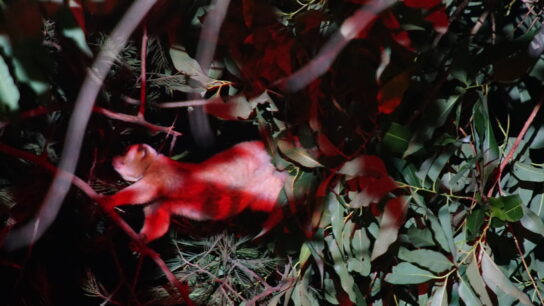
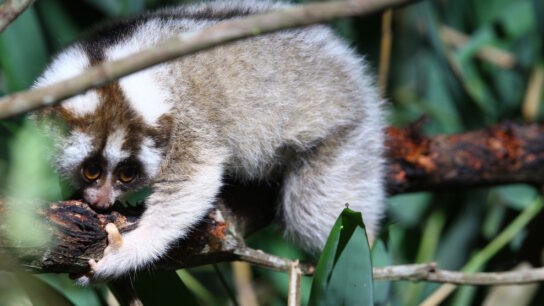
To counteract this, we are introducing a series of videos of these gorgeous animals as they should be. With our rare access to footage of animals in the wild, we hope you can see just how fast the loris can be! How much the move! How many branches they need! How giant their pupils should be. How lovely their fur should look. That is why we film in red and infrared light, so the loris can behave naturally, not terrified by white lights. We hope you can see, as we have done, the real loris, and love them for what they really are.

Experts gather to tackle slow loris trade – Press Release

Sukabumi – last week over 50 people from government agencies, national and international universities, NGOs and rescue centres met in the Cikananga Wildlife Rescue Centre on Java, Indonesia, to discuss the challenges in tackling wildlife trade in Indonesia. Different from other such workshops the focus was on some of the lesser known nocturnal species with a particular emphasis on slow lorises.

Slow lorises are a group of small nocturnal primates that are particularly heavily affected by the illegal pet trade. They occur all over Southeast Asia from India and China south to Indonesia and the Philippines.  Indonesia is home to six of the eight species including the recently described Kayan slow loris.

Anna Nekaris, professor in primate conservation at Oxford Brookes University, who described the new Kayan slow loris, presented the results of her research highlighting the differences between the species. This allows workshop participants to identify the different species they encounter in their day-to-day jobs. She remarked that “the increased diversity that is recognised amongst nocturnal mammals such as the slow lorises make it paramount that law enforcement agencies are able to identify the different species. With increased species numbers it furthermore highlights the need for increased protection of these sometimes overlooked animals”.

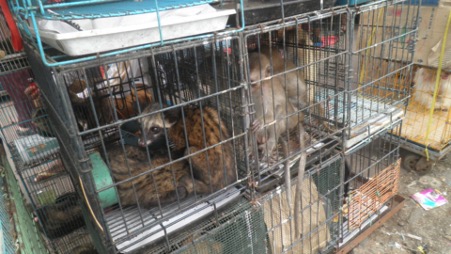
The participants were presented with data on the trade in civets, tarsiers, slow lorises and other wildlife demonstrating the global significance of Indonesia of the trade in these species. This resulted in frank discussions about the challenges the Indonesian government faces when confronted with large scale open trade in protected species. The participant then had the opportunity to view a great number of confiscated animals in the rescue centre. Several then went on to survey the animal markets in Jakarta observing no less than 31 slow lorises offered openly for sale.

Dr Chris Shepherd, deputy director of Traffic Southeast Asia was one of the speakers, and remarked how slow loris trade is actually worsening.

At the end of the workshop it was concluded that there was a clear need for a Southeast Asian wide slow loris conservation action plan as well as an increased understanding of the forces behind the open trade in protected wildlife at more regional scales.

Prof Nekaris concluded “It is inspiring to see that the conservation crises that the faces the slow loris brought together participants from different countries and varying backgrounds to safe an animal that has previously been considered insignificant.”


Note to editors:

Slow lorises (genus Nycticebus) are a group of 8 nocturnal primates that are threatened by habitat destruction and increasingly by trade – they feature frequently in YouTube videos. Slow lorises are protected in all of the 13 range countries in which they occur and are included on Appendix I of the Convention of International Trade in Endangered Species of Wild Fauna and Flora, precluding all international trade.


A film showing the nature of the wildlife trade in Indonesia can be seen here