Loris Sexy Time

The 10th of June 2013 was some night! I entered the forest with our LFP in-house writer Annie Fiorentino, for her first trek every into loris territory. She could not know what a surprise she was going to get!

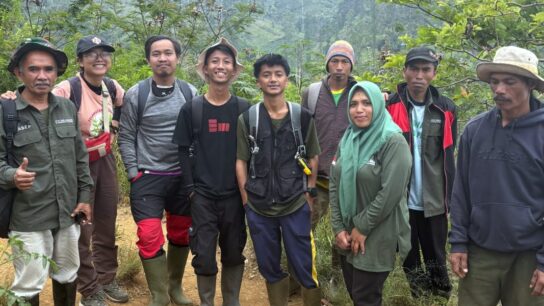
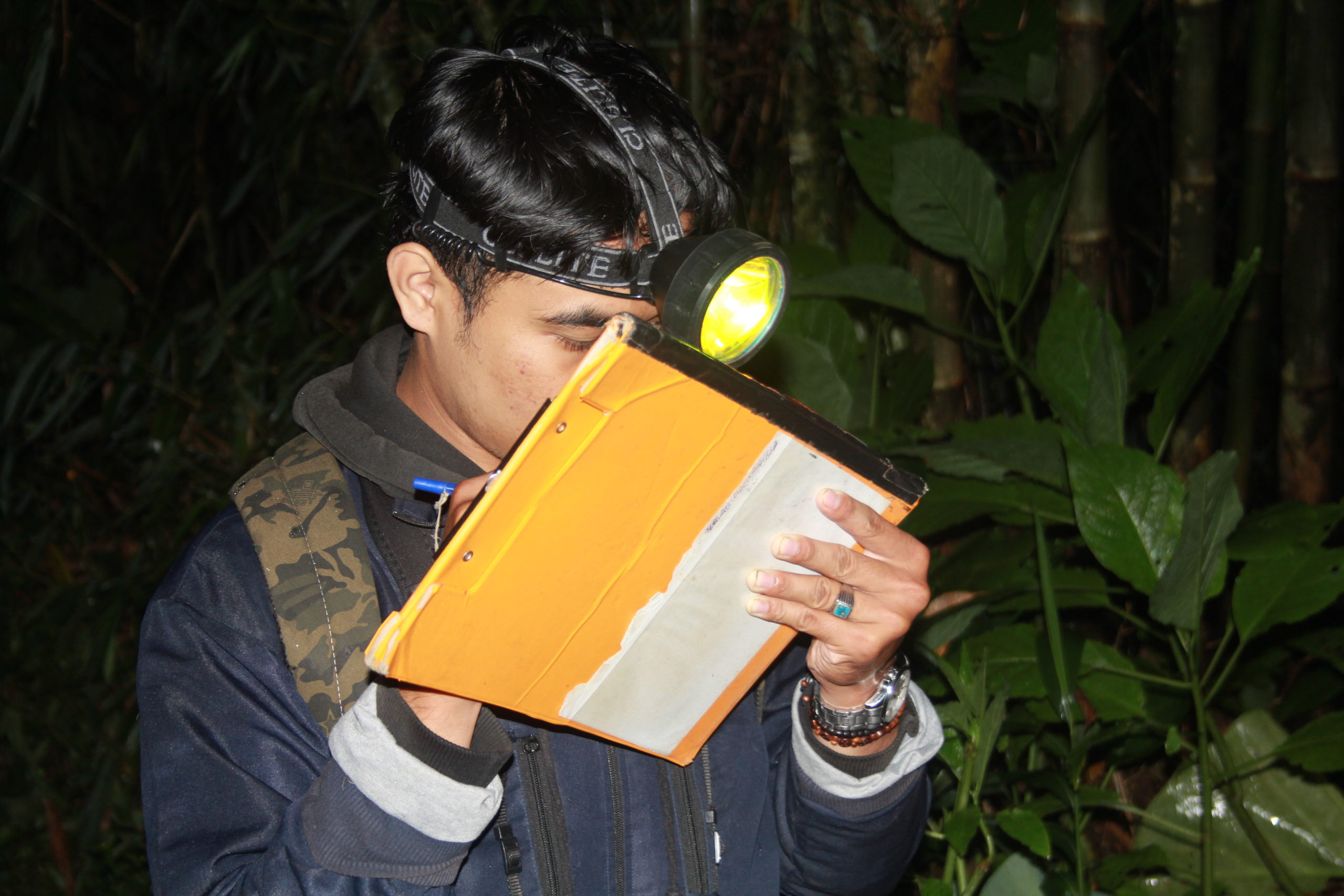
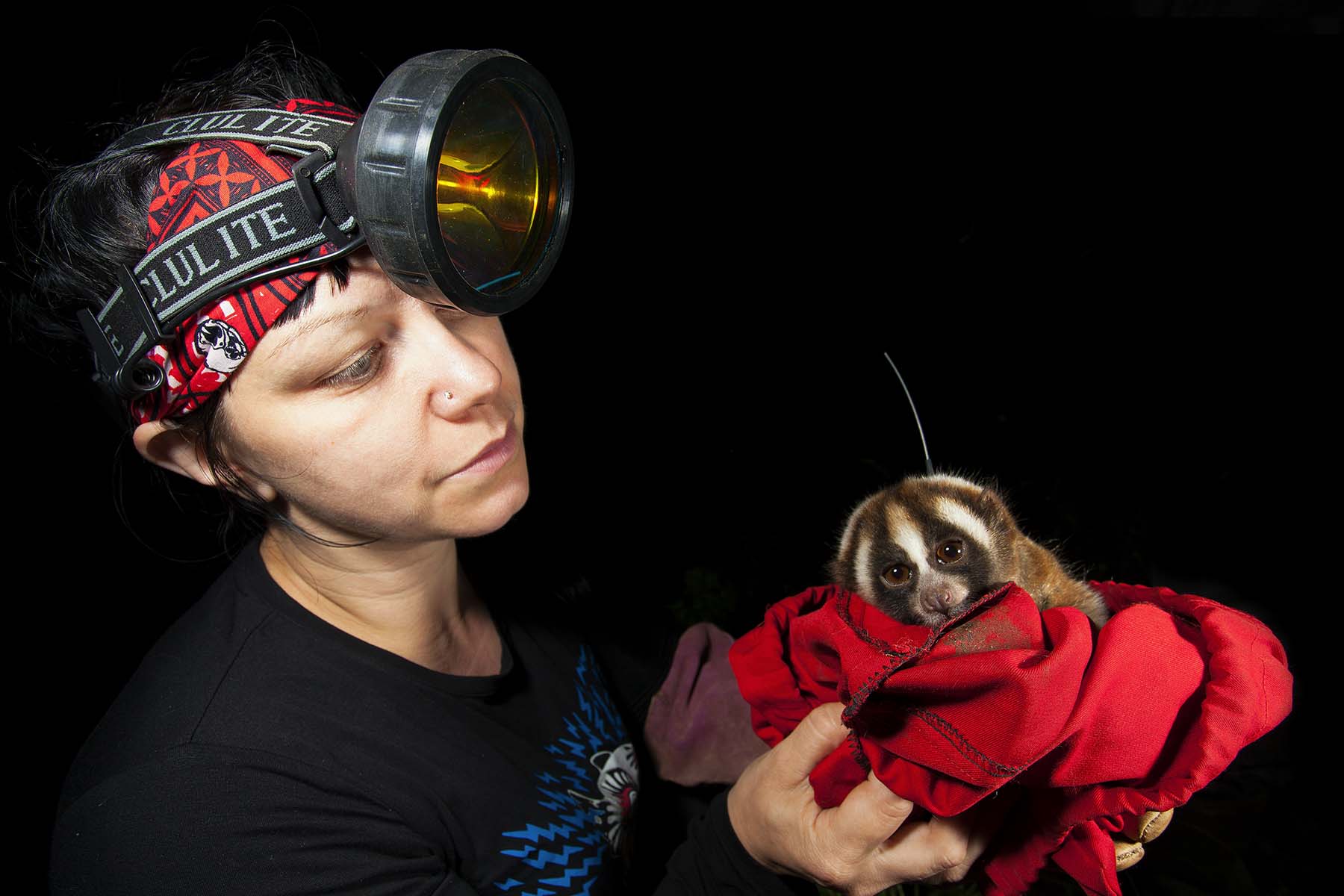
Searching for our favourite loris super mother Tereh with local wildlife photographers Wawan Tarniwan and Muhammed Taufik and our head tracker Dendi Rustandi, we were lucky to see her ‘exposed’ right at the front of the bamboo…but she was not alone! With her was our roaming male Azka, who we thought was a faithful partner to One Eye…but when a loris is about to enter her brief window of ‘sexy time,’ it was clear that Azka was not in the mood for being faithful!

Azka and Tereh were suprised by us, ‘caught in the act.’ When lorises copulate, the male ‘locks’ into the female, so they were not going anywhere! Clearly in the act when we arrived, it lasted another 8 minutes, before they were rudely interrupted. Another male, seemingly with a collar but no signal (so probably our long lost Guntur!) appeared and pounced on Azka. Issuing a growl, they fell 7 m from the tree into the stream! Tereh looked a bit shocked but did not move. After a few minutes, Azka made his way back to his prize, but he was not going to let another competitor ruin his chances. Immediately he started voraciously licking his venom gland, holding his arm out like a strongman, and rubbing it all over his head (an area that another loris would be most likely to attack). After about another ten minutes, he and Tereh meandered off together through the bamboo, with no sign of Guntur.

What a birthday present for me! I have written the story of Tereh and her imaginary baby Bunga, but hopefully in about six months, little Bunga will be born and be part of the safe and thriving population here in Cipaganti.

Some loris love for St Valentine’s!

So are they naughty little animals, hot-footing it from one partner to another? Are loris families torn apart by philandering fathers? No! Endearingly, early studies from the field show that the Javan loris presents a shining example of a healthy uni-male, uni-female family unit. And just in time for Valentine’s Day too, one of their favourite things to do together is spend time in the caliandra flowers sipping nectar—sweet!

Take Tereh, her man Guntur and little baby Tahini. They spend a lot of time together within a 100 m radius, with mum and baby snuggled together in the first few weeks of life and dad reassuringly close by. After that, unusual for primates, it is the man who takes over, with Guntur visiting baby Tahini throughout the night! Of course, we cannot be 100% sure that Gunter is Tahini’s father. Loris paternity tests are a long way down the pipe-line and are surpassed by more pressing concerns such as the components of loris venom! This isn’t Jeremy Kyle you know. That said, ladies have been known to let another man into their lives on occasion (just don’t tell Guntur).

Generally, loris mum, dad and kids live in stable social units or spatial groups. They spend their time allogrooming, following, expressing alternate click-calls and whistles and sleeping in close contact, with parents sharing the shopping responsibly by transferring information on food resources.

They are generally on good terms with the neighbours and interactions between members of overlapping spatial ranges are a genial affair with occasional grooming and whistling. But when there is a spat, look out—you could lose an ear! Other than those rows, we humans could take a gum-leaf from the loris book of manners!


Read the story also in our new newsletter here.

New Videos to Counteract YouTube Horrors – Slow Loris

For many of us, slow lorises are cute. You can put them in a pile of garbage and they still look just that!! CUTE! So it is no wonder that a tortured overweight loris on a dirty pile of sheets essentially being tortured still looks, well, cute (according to some 17 million viewers at any rate)…

For non-experts, who cannot read the expressions of fear in the animals’ faces when they watch videos of pet lorises, who cannot tell how much bright light hurts their eyes, who cannot see how starving they are so they eat bananas and rice rather than their beloved gum and insects, who cannot see how desperate they are for a branch so they grab on to an umbrella, they are still that – CUTE. For us here at the Little Fireface Project, we see the demise of a beloved species for a senseless human gain.

To counteract this, we are introducing a series of videos of these gorgeous animals as they should be. With our rare access to footage of animals in the wild, we hope you can see just how fast the loris can be! How much the move! How many branches they need! How giant their pupils should be. How lovely their fur should look. That is why we film in red and infrared light, so the loris can behave naturally, not terrified by white lights. We hope you can see, as we have done, the real loris, and love them for what they really are.

International team discovers new loris species in Borneo and the Philippines

Although this news should have been released on the 14th of December, the embargo was leaked, so it seems timely that the Little Fireface Project should report on this important news now!

Discovered! New Species of Borneo’s Enigmatic Primate with a Toxic Bite

Three New Species of the Masked Slow Loris are Newly Recognized

The images above show N. menegensis and N. kayan, photographed by Chi’en Lee

An international team of scientists studying the elusive nocturnal primate the slow loris in the jungles of Borneo have discovered three new species. Published in the American Journal of Primatology, the team’s analysis of the primate’s distinctive facial fur markings revealed the existence of one entirely new species, while three species others are being officially recognized as unique.

“Technological advances have improved our knowledge about the diversity of several nocturnal mammals,” said Rachel Munds, Little Fireface Team Member from the University of Missouri Columbia. “Historically many species went unrecognized. While the number of recognized primate species has doubled in the past 25 years some nocturnal species remain hidden to science.”

The slow loris (Nycticebus) is a primate genus closely related to galagos. These primates are nocturnal and can be found across South East Asia, from Bangladesh to China to the island of Borneo. The slow loris is rare amongst primates for having a toxic bite, and is listed as Vulnerable or Endangered on the IUCN Red List.

Slow lorises are recognized by their unique fur colouration on the body and face. While traits such as fur patterns are often used to distinguish between species, nocturnal species are cryptic in colouration and have less obvious external differences. The team’s research focused on the distinctive colourings of Borneo’s slow loris, whose faces have an appearance of a mask, with the eyes being covered by distinct patches and their heads having varying shapes of caps on the top.

Differences among these face masks resulted in recognition of four species of Bornean and Philippine lorises, N menagensis, N. bancanus, N. borneanus and N. kayan. Of these Nycticebus kayan is a new group unrecognised before as distinct. This new species is found in the central-east highland area of Borneo and is named for a major river flowing in its region, the Kayan.

The recognition of these new species strongly suggests that there is more diversity yet to be discovered amongst slow lorises throughout their range. Yet in Borneo and the Philippines itself, the area is threatened by human activity so the possibility that more slow loris species exist in small and fragile fragments, raising urgent questions for conservation. “The pet trade is a serious threat for slow lorises in Indonesia, and recognition of these new species raises issues regarding where to release confiscated Bornean slow lorises, as recognition by non-experts can be difficult,” says Prof Nekaris.


———————————————————————————————————————–

This study is published in the American Journal of Primatology. To request a copy contact sciencenewsroom@wiley.com or +44 (0) 1243 770 375


Full Citation:

XX Wiley, December 2012, DOI: xxxx


Paper URL: http://doi.wiley.com/ XXXXXDOIXXXXX


Contact the Author: The authors can be contacted via:

Dr Rachael Munds, University of Missouri press office:

Tim Wall
573-882-3346
walltj@missouri.edu


Dr Susan Ford, Southern Illinois University

Ron Sievers

618 | 453.2813
rsievers@siu.edu


Prof A Nekaris, Oxford Brookes University

Matthew Butler

01865 484630

m.butler@brookes.ac.uk


About the Journal:

The objective of the American Journal of Primatology is to provide a forum for the exchange of ideas and findings among primatologists and to convey our increasing understanding of this order of animals to specialists and interested readers alike.


Journal URL: http://onlinelibrary.wiley.com/journal/10.1002/(ISSN)1098-234


Animal Market Horrors

During monthly market surveys, the Little Fireface Project team monitors wildlife trade in some of Indonesia’s most notorious illegal markets, in the hopes that things will get better, and those breaking the law will be prosecuted. Sadly, the number of lorises we see for sale just is not decreasing. Indonesia has some of the best laws in Asia to protect their wildlife but sadly, as these photos in a public market show, they are not always enforced.

Part of our programme is thus also to work with international organisations like TRAFFIC to provide training materials so that enforcement officers can be sure they can identify the species that are being traded, so there is no doubt which are protected. Of course, the animal welfare issues of the unprotected species is also abysmal and is an issue in its own right, as the photographs of the baby monkeys show.

Please sign our petition to help end this cruel and crushing trade.

Living with the Gremlins

The Little Fireface Project team hopes to save the slow loris through studying their ecology, and inspiring people through education so that they gain empathy towards lorises, thereby empowering them to save them. This new video, produced and written by the team in Java, envelopes all those principles. Please watch and share. We hope that videos like this will one day overtake all those horrible videos of pet lorises that pervade YouTube and that people will appreciate the wild lorises and those people who are striving to save them.


Bloody lorises!!

Why on earth are lorises the only venomous primates? Well they might use it to challenge each other! Male lorises fiercely pursue females, and many lorises have horribly healed scars and especially head and finger wounds, but rarely have we seen a fresh one to see just how it, well, festers (yuck!). Well, just in time for Halloween, our Guntur seems to have been fighting for his lady Tereh (yes I know you thought he was ‘married’ to Ena – he is not the gentleman you thought him) and slow loris researcher superstar Jo Rode with her Eagle eye noted his bloody toe! We will let you know how it heals, and what toll Guntur’s opponent’s venom may have taken on his lovely toe!

Meet Pak Dendi!

Continuing our series of interviews with our fabulous team out in Cipaganti, Java, today we introduce you to Dendi Rustandi, a 34-year-old entrepreneur turned slow loris expert extraordinaire! Our Research Fellow Sisil Putri conducts the interview…

  1.  Tell me about your background staying in the Cipaganti village?

I was born and raised in Pengalengan (Bandung) in 1978. I move out to Cipaganti village following my grandmother after I finished my high school and I met my wife here; she’s local to Cipaganti and we decided to live here.

2. What do you like about living in Cipaganti village?

I love the village atmosphere, the cold weather, a lot of fresh vegetables you can get here easily, and how the people know each other so well and are so kind to each other.

3. What’s your impression on working for “Little Fireface Project”?

The project is challenging for me as I didn’t know how to communicate with English,  but  now I can understand English a little. Also I found a lot of interesting new experiences from the project and so happy I have known some “bule” (foreigners) from this project.

4. What is your favourite thing and the hardest thing from the project ?

My favourite is to see slow loris carry the baby with them and the baby is just clinging there; it was so sweet and so happy to see.

The hardest thing about the project is when we have to go through bushes and bamboos; it makes slow loris hard to find and hard to see.

5. Tell me what you think the impact on yourself of the difference before and after you joined the project?

Through the project I can now  say that I understand English a bit and get nice salary from the project and I understand about kukang behavior from the research. It is such an experience to work in this project and revealing my village secret of having slow loris in the area and I realize as local people, we need to save them.

Before I know what kukang is and what they do, for me and family they are a very scary animal because I heard there were some people in our village who got bitten by kukang, which made them have treatment in the hospital. But after I work in this project and I know kukang better, I know understand what is kukang and their behaviour. I also get bitten by kukang from handling, but thank God that it was just okay by wearing gloves and I didn’t need to go to the hospital. From this project I become to love to join the research every night to see these cute and rare animal.


‘Tim Fireface’ – Meet Pak Acong!

We study the Javan slow loris in Cipaganti village in Garut District Java with an international  team. But perhaps the most important team members are our local rangers, who PhD student Johanna Rode has trained over the last several months. They are learning to follow the lorises via radio tracking and to collect behavioural and ecological data. Despite living beside the lorises their whole lives, this is the first time they are really seeing what the lorises are doing! Read below the impression of our Junior Ranger Pak Dede ‘Acong’ Ahmad’s impression of working on “Projek Muka Geni”.

1. Tell me about your background staying in the Cipaganti village?

My great-grand mother was a local person from Cipaganti and stayed in Cipaganti for her whole life, so I was born and raised here.

2. What do you like about living in Cipaganti village?

I love the clean air, the positive and strong eastern culture, mutual cooperation working within the society, the solidarity among the village people, a strategic place for having plantations (his background is the son of a carrot dealer) and we have a rare history.

3. What’s your impression on working for “Little Fireface Project”?

I found that working in this project is so fun because I have learned a lot of new things this project and from this work.

4. What is your favourite thing and the hardest thing from the project?

My favourite is I can know the behaviours of Javan slow loris and come to learn new things from a lot of ‘bule’ (foreign people) who come here. The hardest part of the project is to stay awake during the night especially during the cold breeze of the field conditions!

5. Tell me the what you think the impact to yourself has been before and after you joined the project?

Before, I didn’t know anything about kukang earlier and only had activities in the day. I also didn’t realize the importance of sleeping arrangement in my life. After, I now know various behaviours of kukang, have day and night activities and am able to manage both my sleeping and activities time better than before.